
言語選択
Center for ELFCenter for English as a Lingua Franca
- HOME
- Center for ELF
A Pioneering Center for
Message from the Director
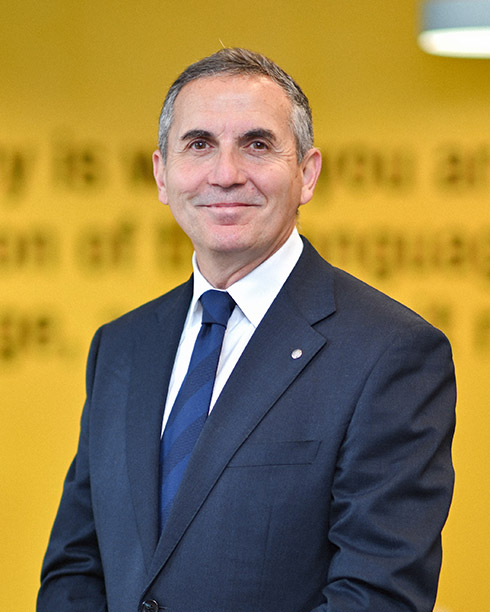
Welcome to the Center for English as a Lingua Franca (CELF) at Tamagawa University. Since its establishment in 2014, CELF has been guided by the conviction that meaningful English proficiency does not require imitation of so-called ‘native speakers’. Rather, it emerges through the context sensitive and functional use of language and involves adaptation, accommodation, negotiation, and co-construction of understanding. As English increasingly functions as a contact language across borders, professions, and cultures, these communicative practices motivate CELF’s work.
Our team of teacher researchers brings a range of linguistic and cultural backgrounds and pedagogical approaches, and CELF encourages reflective, inquiry driven teaching to help students develop the capacity for effective communication in diverse contexts. We aim to enable learners to participate confidently in multilingual environments and contribute meaningfully to communities locally and globally.
We gratefully acknowledge the work of CELF First Director, Professor Dr Masaki Oda, who wrote to students:
“You will not be penalized for not being able to imitate ‘native speakers’ perfectly. Instead, we will constantly reflect what you can do, and gradually improve English as it is used in the real world, step by step.”
We invite you to explore our homepage and learn more about ELF teaching, learning, and research.
Director, CELF Blagoja Dimoski
Faculty

Faculty members
-
Director
Dimoski, Blagoja
-
Associate Director
Kuroshima, Satomi, Ph.D.
-
Chaikul, Rasami
Leichsenring, Andrew, Ph.D.
McBride, Paul
Milliner, Brett
Mogi, Yuta, Ph.D.
Nakamura, Sachiko, Ph.D.
Novikova, Natalia, Ph.D.
Okada, Tricia, Ph.D.
Stevenson, Robert
Yujobo, Yuri Jody
-
First Director
Oda, Masaki, Ph.D. (April 2014 - March 2020)
-
Second Director
McBride, Paul (April 2020 - March 2026)
Part-time faculty members
-
Around 40 instructors from around the world
Multilingual faculty members
To our knowledge, Tamagawa University’s Center for English as a Lingua Franca (CELF) is among the world’s first centers to apply ELF research to teaching English and teaching though English for academic purposes.
Even though native-speakerism and associated provincialism are strongly ingrained in Japanese society (e.g., Houghton & Rivers, 2013), CELF has valued diversity on a global scale in the communication experiences of its teaching staff. They are originally from across the world, and at present, largely from Asia, Australasia, the Americas, and Europe. Whether full- or part-time, new applicants are scrutinized for scholarly appreciation and pedagogical application of ELF research and intercultural background, along with academic qualifications and teaching experience.
CELF policy and practice supersede distinction between ‘native’ and ‘non-native’ English speakers. Instead, the founding director Masaki Oda clearly states that “monolingual English-speaking teachers would not meet the needs of our ELF program” (Oda, 2019: 265).
Faculty’s countries of origin
(As of 2026)
19 countries
Australia, Brazil, Canada, China, Germany, Iran, Ireland, Italy, Japan, Peru, Philippines, Russia, Slovakia, Sri Lanka, Thailand, United Kingdom, United States, and Vietnam
Faculty’s first or strongest
languages (As of 2026)
14 languages
Czech, Chinese, English, German, Japanese, Italian, Persian, Portuguese, Russian, Sinhalese, Slovak, Tagalog, Thai, and Vietnamese
References
Houghton, S., & Rivers, D. J. (Eds.). (2013). Native-speakerism in Japan. Multilingual Matters.
Oda, M. (2019). Beyond global English(es). In K. Murata (Ed.), English-medium instruction from an English as a lingua franca perspective (pp. 259-270). Routledge.
History
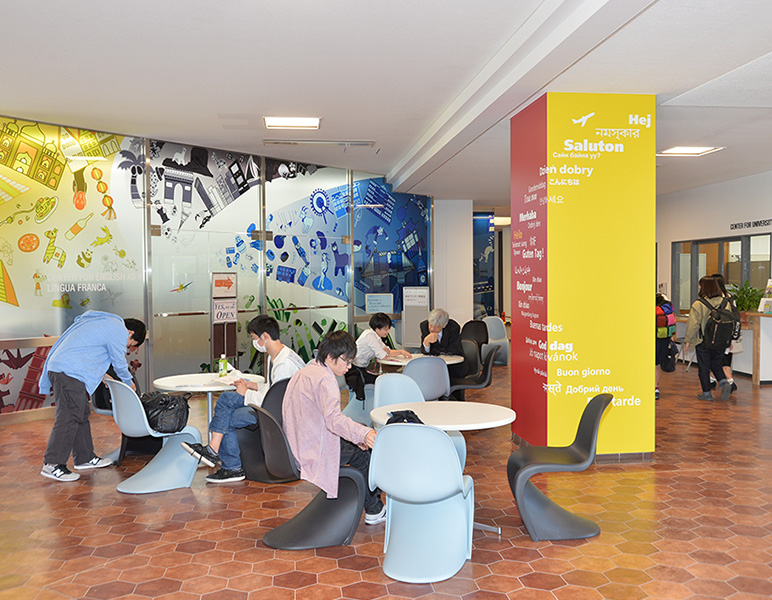
Tamagawa University’s English as a Lingua Franca (ELF) program started in 2013, with around 1,000 students at the College of Arts and Sciences and the College of Tourism and Hospitality. The summer and winter ELF sessions, as well as special ELF classes for 12th graders at Tamagawa High School, also started in the same year.
Tamagawa University’s Center for English as a Lingua Franca (CELF) was established in the following year, and it has offered English education to an increasing number of students across the humanities and sciences:
approximately 1,500 students in 2014, 2,500 in 2015, 2,700 students in 2016, and 2,800 students in 2019 onwards. In 2019, the ELF program became the integral part of curricula in all the eight Tamagawa colleges (i.e., Humanities, Agriculture, Engineering, Business Administration, Education, Arts, Arts and Sciences, and Tourism and Hospitality). In 2023, the CELF diversified its program by offering 17 courses across four academic levels to 17 departments in eight colleges.
CELF is not just a pedagogical center to design, implement, and evaluate the university-wide English program. It also serves as a research center.
Ever since 2015, CELF has organized monthly workshops for its faculty and staff, inviting scholars from both inside and outside the university. Before the COVID pandemic outbreak in 2020, CELF special faculty development events featured scholars from overseas, and specifically from Austria, China, Indonesia, South Korea, Thailand, and the UK. In these workshops and events, CELF faculty members and scholars actively shared ELF-aware research and teaching ideas, some of which have also been distributed and further developed through CELF academic forums and publications.
On 5 March, 2015, the first CELF Forum took place under the title of Language teaching in the Asian context. On 22 August, 2017, in collaboration with ELTama (a group of Tamagawa alumni English teachers at the Graduate School of Humanities), CELF hosted its first annual CELF-ELTama Forum for English Language Teaching (ELT) to connect ELF research with ELT in Japan and overseas.
Meanwhile, CELF launched its journal called The Center for English as a Lingua Franca Journal in April 2015. After publishing its sixth volume in April 2020, CELF decided to take over the Sciendo (De Gruyter Poland) Open journal of Englishes in Practice from the University of Southampton, UK. In 2021, CELF started to publish both The Center for English as a Lingua Franca Forum and Englishes in Practice, the former reviewing research and pedagogy at CELF, and the latter disseminating pioneering research related to global communication among English users.